SBA.gov Platform Modernization Case Study: Resetting the Technical Foundation of SBA’s Public Site

In March 2026, SBA’s Office of the CIO signed off on a foundational shift for SBA.gov. Rather than continue investing in the site’s existing Drupal 11 platform, the team will rebuild the site from the ground up in WordPress. This is the story behind it, and how it’s already playing out.
SBA.gov is the front door for small business owners and the public at large. It has to perform double duty hosting stable, evergreen program content while also flexing to support fast-moving, agency-directed campaigns. Today, the site runs on Drupal 11 and carries roughly 17,000 content items. Two problems kept surfacing from user and stakeholder feedback.
The first challenge was findability. People coming to the site with a specific need (eg. a form, program, or piece of guidance) often couldn’t locate it. SBA’s core mission is to help small businesses, so if those businesses can’t find what they need, that’s a big miss for the agency.
The second challenge was technical debt. The current Drupal build leans heavily on custom-coded solutions, which means routine changes and maintenance depend on developer involvement. OCIO has been pushing the organization toward off-the-shelf tools that reduce that dependence and allow for smaller, nimbler teams.
There was also a more immediate, practical driver. The Office of Communications & Public Liaison (OCPL) regularly needs to stand up custom landing pages and campaign content on short notice, in support of agency priorities that can’t wait for a development sprint. In the current system, that kind of quick-turn project usually requires a developer, and template options are limited. WordPress is the platform OCPL specifically wanted for the flexibility it offers content editors.
The team evaluated realistic paths, documented in a formal comparison for CIO approval. A headless architecture and a static site generator were both ruled out early. A headless Drupal implementation would have increased the need for developers, working against OCIO’s direction, and a static generator couldn’t reasonably support the site’s large content inventory.
That left refactoring Drupal versus rebuilding in WordPress. Refactoring would avoid migration risks and let technical debt be paid down incrementally but wouldn’t fully reduce custom code. A refactor also risked increasing developer dependence, and it wouldn’t deliver the layout and editing flexibility OCPL needed. Rebuilding in WordPress took the harder short-term path but offered a cleaner solution. It opened the door to off-the-shelf (OTS) tools, cut developer reliance, and tapped into a much larger talent pool for ongoing support. The tradeoffs were real though, since WordPress carries more security exposure as a frequently targeted platform, and there was no guarantee every Drupal function has a ready-made WordPress equivalent.
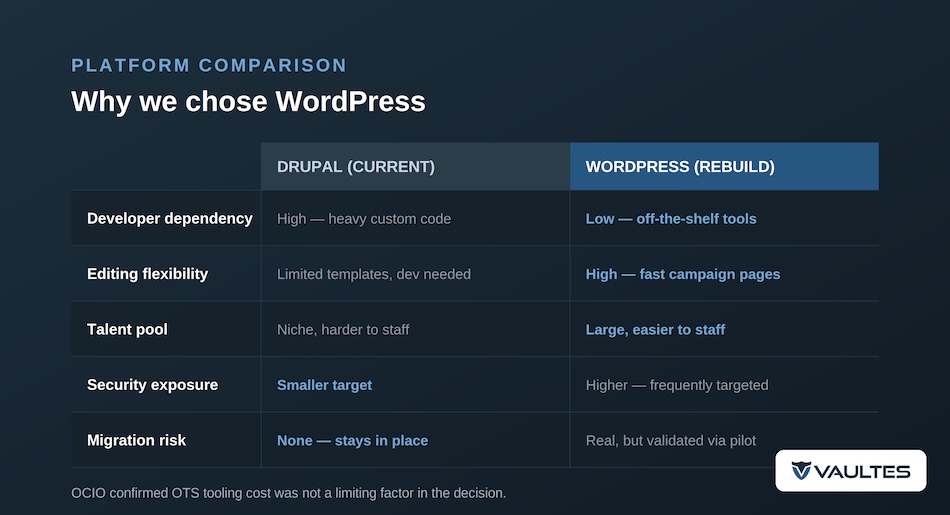
Based on our formal comparison, OCIO decided that SBA.gov will be rebuilt on WordPress rather than refactored in place.
The case for WordPress came down to it solving both core problems, findability and technical debt, while also delivering the editing flexibility stakeholders were asking for and aligning with direction from OCIO, OCPL, and the executive office. A refactor would have meant continuing to build on the same foundation that produced the current problems. Even a well-executed refactor wouldn’t give OCPL the fast, layout-flexible authoring experience central to their use case.
Our decision needed to weigh long-term considerations as well, such as staffing and maintainability. WordPress’ wider developer talent pool further tipped the decision in that platform’s favor. OCIO was also explicit that the cost of OTS tools and plugins wasn’t a limiting factor if the trade-offs were worth the additional expense.
The rebuild also creates a one-time opportunity to shed outdated content rather than migrating all 17,000 items to the new platform, allowing SBA to streamline content for future maintainability.
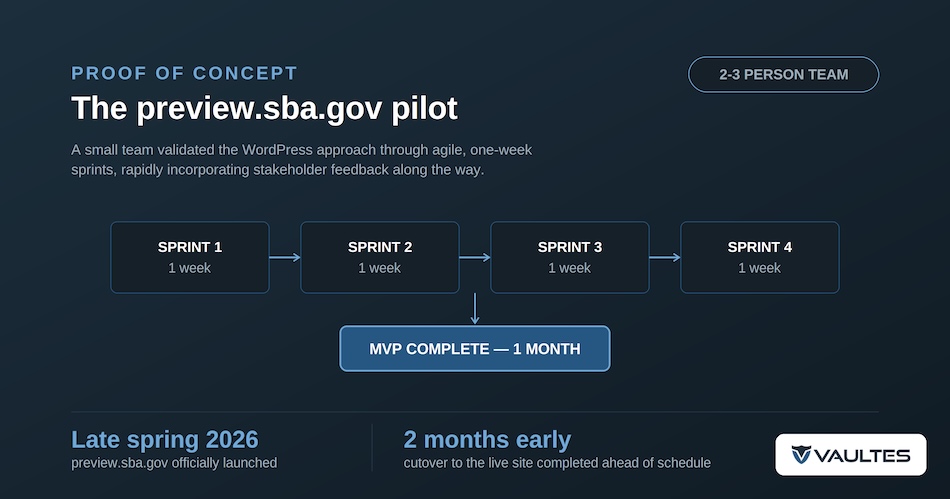
Before the full-scale effort got underway, the team validated the WordPress approach with a working pilot: preview.sba.gov.
The pilot ran on the same agile principles the broader program leans on: a small team of two to three people, working in one-week design sprints, iterating quickly and rapidly incorporating stakeholder feedback. The result was an MVP completed within a single month. We officially launched preview.sba.gov in late spring 2026.
Our team completed the preview.sba.gov to sba.gov cutover two months ahead of schedule, an early sign that the WordPress approach could deliver on the flexibility and speed OCPL needs.
Now comes the difficult work of maintaining two systems while migrating the legacy Drupal system to the WordPress platform. The team is maturing the WordPress themes, developer documentation and site style guide alongside the migration work.
The decision to rebuild SBA.gov on WordPress represents a foundational architecture reset. The team reached the decision through a structured evaluation of viable alternatives and validation through a working pilot that met and exceeded its delivery targets.
This work is just one example of how our teams support Federal agencies in simplifying digital services by doing more with less, working lean and fast, and being responsible stewards of taxpayer funds.
Vaultes is a leading provider of cybersecurity solutions, dedicated to protecting organizations from evolving cyber threats. Our team of experts delivers tailored strategies and advanced technologies to ensure robust and resilient security postures.
More Info